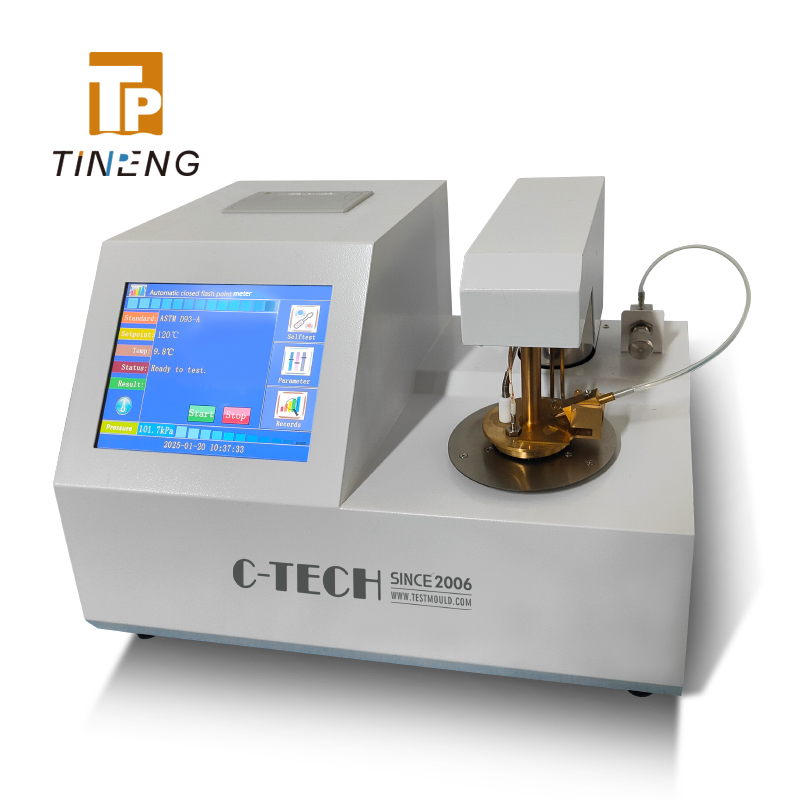
It is used to determine the flash point of petroleum products by Pensky‑Martens closed‑cup method. It adopts microcomputer control, adaptive PID control algorithm, and platinum alloy heating wire ignition, which is safe, stable and accurate. It conforms to ASTM D93 and is widely used in petroleum, chemical, power, environmental protection, railway, scientific research and other sectors. It is an ideal instrument for closed‑cup flash point testing.
STANDARD
- ASTM D93
Get Wholesale Price
It is used to determine the flash point of petroleum products by Pensky‑Martens closed‑cup method. It adopts microcomputer control, adaptive PID control algorithm, and platinum alloy heating wire ignition, which is safe, stable and accurate. It conforms to ASTM D93 and is widely used in petroleum, chemical, power, environmental protection, railway, scientific research and other sectors. It is an ideal instrument for closed‑cup flash point testing.
FEATURES
-Adopts new high‑speed signal processor control and adaptive PID control algorithm to automatically adjust the temperature rise curve according to standard requirements;
-Built‑in automatic atmospheric pressure detection chip, which automatically measures, corrects, and adjusts the flash point value.
-The instrument automatically completes the lifting, stirring, ignition, detection, alarm, cooling, and printing processes.
-Gas‑free platinum alloy heating wire ignition method, which is safe, stable, reliable, and provides high testing accuracy.
-Differential detection with automatic system deviation correction, automatic stop of detection and alarm when temperature exceeds the limit;
-Comes with 12 sets of temperature point corrections.
-Automatically display the furnace temperature, allowing users to check the temperature at any time for convenient sample preparation.
TECHNICAL SPECIFICATIONS
Display: 8‑inch 65K (800*600 resolution) touchscreen
Measurement method: thermocouple differential detection
Display range: -59.9℃ to 400℃
Measurement range: Ambient temperature -400℃ (Samples must be frozen before determining flash point below 0℃)
Resolution: 0.1℃
Repeatability: Allowable tolerance of ±1℃ for flash point ≤110℃, and ±2℃ for flash point >110℃.
Heating rate: Conforms to ASTM D93 Procedure A, B and C;
Procedure A: heating rate 5‑6℃/min, stirring speed 90‑120rpm;
Procedure B: heating rate 1‑1.5℃/min, stirring speed 250±10rpm;
Procedure C: heating rate 2.5‑3.5℃/min, stirring speed 90‑120rpm
Printer: Low‑energy high‑speed thermal printer, 56mm paper width
Temperature detection: Imported platinum resistance thermometer (Pt100Ω)
Ignition method: Gas‑free electronic ignition
Self‑test function: Automatic diagnosis of instrument malfunctions
Cooling method: Forced air cooling
Dimensions: 450×280×290 mm
Weight: Approx. 15 kg